
- Introduction
- Top 10 Gold-Producing Countries in Africa
- African Gold Comparison Table
- Legal Gold Export Process in African Countries
- Industrial vs Artisanal Mining
- How to Buy Gold from Africa
- Cheapest African Countries to Buy Gold
- Major Gold Mines in Africa
- Conclusion
Top 10 Gold-Producing Countries in Africa 2026|New Rankings & Production Data
Africa remains one of the world’s richest continents in gold resources, producing a significant share of global supply each year. In 2026, countries like South Africa, Ghana, Sudan, Mali, Tanzania, and Uganda lead the continent in gold production, combining both industrial mining and artisanal output. Understanding the top gold-producing nations helps investors, exporters, and buyers identify reliable sources, competitive prices, and emerging opportunities in African gold markets. This guide highlights annual production, major mining regions, and market potential for each country.

Top 10 Gold-Producing Countries in Africa (2026)
- Ghana
Africa’s Largest Gold Producer
Ghana is expected to continue leading Africa in gold production in 2026. The country hosts world-class mines such as Obuasi, Tarkwa, Ahafo, and Damang, operated by major international companies. Gold is Ghana’s top export, supported by strong regulations, modern infrastructure, and reliable export systems.
- South Africa
Historic Giant with Deep Gold Reserves
South Africa remains one of Africa’s most important gold producers despite declining output compared to previous decades. The Witwatersrand Basin still contains some of the richest gold deposits globally. Advanced mining technology keeps production viable in 2026.
- Sudan
Rapidly Growing Gold Economy
Sudan ranks among Africa’s top gold producers due to extensive artisanal and small-scale mining. Gold has become Sudan’s leading export commodity, playing a crucial role in foreign exchange earnings despite political challenges.
- Mali
West Africa’s Gold Powerhouse
Mali consistently ranks among Africa’s top gold producers, with gold contributing more than 70% of export revenues. Major operations such as Loulo-Gounkoto, Fekola, and Sadiola continue to drive production in 2026.
- Burkina Faso
High-Grade Gold Deposits
Burkina Faso has rapidly expanded its gold sector over the past decade. Large-scale mines like Essakane and Houndé support steady output. Gold remains the country’s most valuable natural resource in 2026.
- Tanzania
East Africa’s Leading Gold Producer
Tanzania continues to dominate gold production in East Africa. Major mines, including Geita, Bulyanhulu, and North Mara, ensure stable output. Improved mining regulations and state participation have strengthened the sector.
- Democratic Republic of Congo (DRC)
Untapped Gold Potential
The DRC holds vast, largely unexplored gold reserves, particularly in Ituri, South Kivu, and Maniema. While artisanal mining dominates, industrial gold projects are expanding in 2026, increasing export potential.
- Kenya
Emerging Gold Producer in East Africa
Kenya’s gold sector is growing steadily, driven by mining activity in Migori, Kakamega, and Siaya counties. With improved licensing, exploration, and foreign investment, Kenya is positioning itself as a rising gold producer in Africa by 2026.
- Uganda
Strategic Gold Hub in the Great Lakes Region
Uganda has become a major gold trading and refining hub in East Africa. Gold production occurs in Busia, Mubende, and Karamoja, while refined gold exports pass through Kampala and Entebbe. In 2026, Uganda plays a key role in regional gold supply chains
- Zimbabwe
Gold-Rich Greenstone Belts
Zimbabwe possesses extensive greenstone belts hosting both industrial and artisanal gold mining. Gold remains the country’s largest foreign currency earner in 2026, supported by the increasing formalization of small-scale miners.
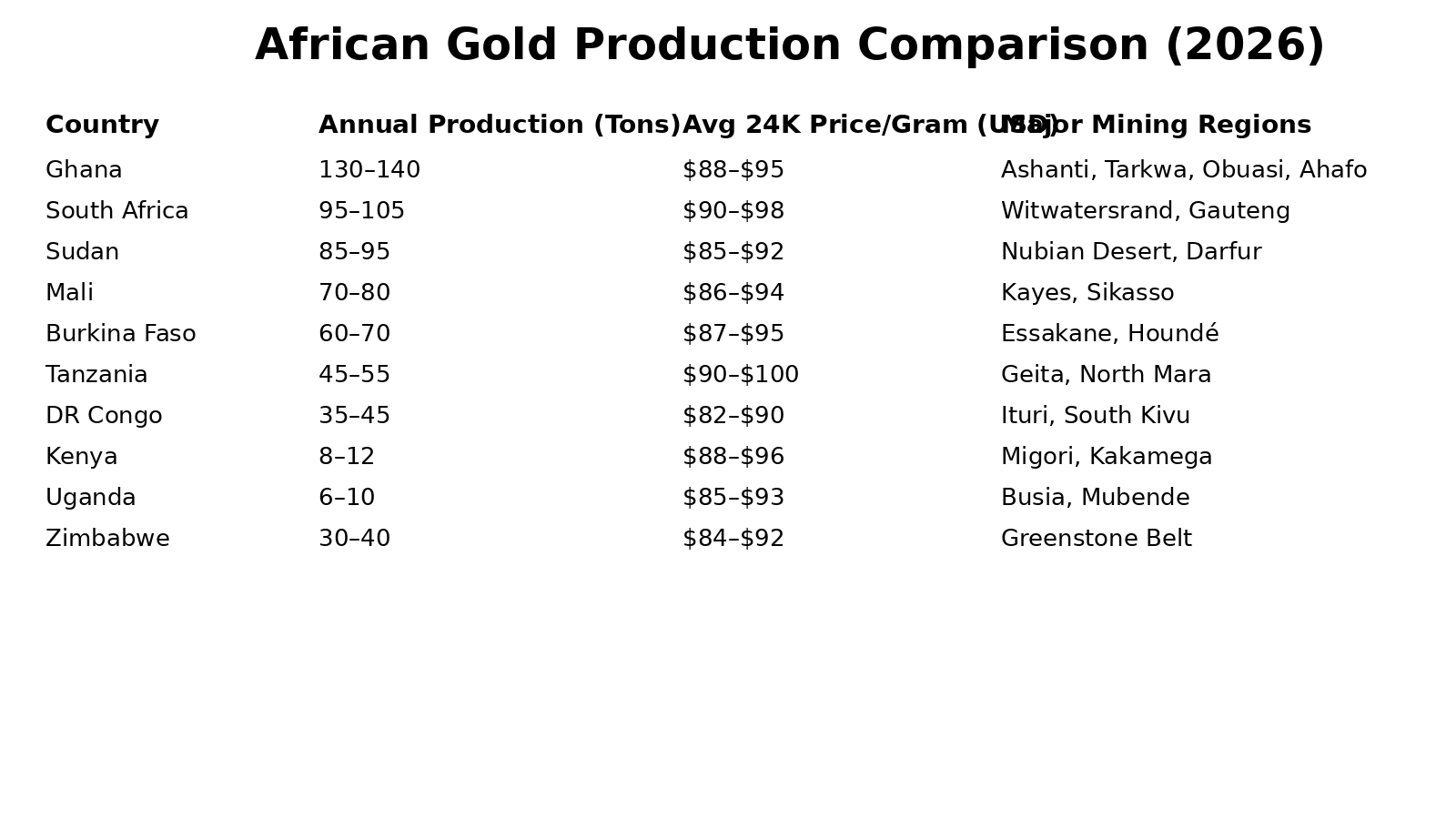
African Gold Comparison Table (2026)
| Country | Annual Gold Production (Approx. Tons) | Avg 24K Gold Price / Gram (USD) | Major Gold Mining Regions |
| Ghana | 130 – 140 tons | $88 – $95 | Ashanti, Western Region (Tarkwa, Obuasi), Ahafo |
| South Africa | 95 – 105 tons | $90 – $98 | Witwatersrand Basin, Gauteng, Free State |
| Sudan | 85 – 95 tons | $85 – $92 | Nubian Desert, Darfur, River Nile State |
| Mali | 70 – 80 tons | $86 – $94 | Kayes, Sikasso, Loulo-Gounkoto |
| Burkina Faso | 60 – 70 tons | $87 – $95 | Essakane, Houndé, Boungou |
| Tanzania | 45 – 55 tons | $90 – $100 | Geita, Bulyanhulu, North Mara |
| DR Congo (DRC) | 35 – 45 tons | $82 – $90 | Ituri, South Kivu, Maniema |
| Kenya | 8 – 12 tons | $88 – $96 | Migori, Kakamega, Siaya |
| Uganda | 6 – 10 tons | $85 – $93 | Busia, Mubende, Karamoja |
| Zimbabwe | 30 – 40 tons | $84 – $92 | Greenstone Belt, Kadoma, Midlands |
Legal Gold Export Process in African Countries (Step-by-Step Guide)
Gold export from African countries is legal when done through licensed channels and in full compliance with government regulations. While requirements vary slightly by country, the core legal process is almost the same across Africa.
1. Gold Sourcing from Licensed Sellers
The process starts with sourcing gold from:
- Licensed mines
- Authorized artisanal miners
- Registered gold dealers
Important: Buying gold from unlicensed sellers makes the export illegal, even if the gold is genuine.
2. Assay & Purity Verification
Before export, gold must be tested at a government-approved assay laboratory to determine:
- Purity (e22K, 23K, 24K)
- Weight
- Composition
Documents issued:
- Assay report
- Certificate of purity
Note. This protects buyers and ensures transparency.
3. Application for Gold Export License
An exporter applies for an official gold export permit/license from the relevant authority, such as:
- Ministry of Mines
- Minerals Commission
- Mining Commission
Requirements usually include:
- Company registration documents
- Valid trading/export license
- Assay certificate
- Sales contract or invoice
4. Payment of Royalties, Taxes & Fees
Most African governments require:
- Royalty payment (typically 3–5%)
- Export levies
- Administrative fees
Note. Payments must be officially receipted and declared.
5. Government Inspection & Valuation
In many countries, authorities will:
- Physically inspect the gold
- Verify assay results
- Confirm declared value
Some countries require:
- Government sealing of the gold
- Official valuation certificate
6. Customs Clearance & Documentation
The exporter submits documents to customs, including:
- Export permit
- Assay certificate
- Certificate of origin
- Commercial invoice
- Packing list
- Tax clearance
Once approved, customs issues clearance for export.
7. Secure Packaging & Sealing
Gold is:
- Packed according to international standards
- Sealed under government supervision
- Labeled with export reference numbers
This ensures traceability and tamper protection.
- Shipment via Authorized Exit Points
Gold exports are done through:
- Approved international airports
- Authorized cargo handlers
Shipment includes:
- Airway bill
- Insurance (recommended)
- Customs escort (in some countries)
9. Import Clearance in Destination Country
The buyer completes:
- Customs declaration
- Payment of import duties (if applicable)
- Refinery or vault acceptance
Legal documentation ensures smooth clearance.
- Typical Timeline for Legal Export
3–5 working days, depending on:
- Country regulations
- Quantity
- Government inspection requirements
Key Risks to Avoid When Buying Gold in Africa
- Buying from Unlicensed or Illegal Sellers
One of the biggest risks is purchasing gold from sellers who are not licensed by the government or mining authorities. Illegal gold may be confiscated, and buyers can face legal penalties or financial losses.
How to avoid: Always verify mining licenses, dealer permits, and export approvals before making any payment.
- Fake or Under-Purity Gold
Some sellers misrepresent gold purity, selling plated, mixed, or under-karat gold instead of genuine 24K or 22K gold. This is common in unregulated markets.
How to avoid: Demand an independent assay report from a recognized laboratory before finalizing the transaction.
- Advance Payment and Payment Fraud
Scams often involve requesting large advance payments and disappearing once funds are sent. Fake documents and false promises are commonly used.
How to avoid: Use secure payment methods, escrow services where possible, and avoid full upfront payments without verified documentation.
- Export and Documentation Problems
Gold bought without proper export documents can be seized at airports or borders. Missing permits, export licenses, or customs clearance can lead to delays or total loss.
How to avoid: Ensure all export requirements are met, including export permits, customs declarations, and refinery certificates.
- Price Manipulation and Hidden Costs
Some sellers quote attractive prices but later add hidden charges such as taxes, security fees, transport costs, or “government approvals.”
How to avoid: Request a clear written breakdown of the total cost and compare prices with international gold rates before agreeing.
- Poor Security and Logistics Handling
Gold transactions involve high value and require secure storage, transport, and delivery. Poor handling increases the risk of theft, loss, or damage.
How to avoid: Work only with sellers who use insured logistics, secure vaults, and reputable shipping companies.
How to Buy Gold from Top Producing Countries in Africa (2026 Guide)
Africa is home to some of the world’s richest gold reserves. Countries like Ghana, South Africa, Tanzania, Sudan, Mali, Uganda, and the DRC supply high-purity gold to buyers across Europe, Asia, and the Middle East. However, buying gold safely requires following the right process.
Step 1: Identify the Right Gold-Producing Country
Choose a country based on your goal (price, volume, logistics, or refinery access):
- Ghana & South Africa. Large-scale, well-regulated production
- Tanzania & Mali. Reliable industrial mines and exports
- Uganda & Kenya. Competitive prices and regional trading hubs
- DRC & Sudan. High supply but requires strict due diligence
Tip: East and West Africa often offer lower origin prices than global retail markets.
Step 2: Work Only with Licensed Gold Dealers or Exporters
Never buy gold from individuals without documentation. A legitimate seller should provide:
- Mining or dealer license
- Company registration documents
- Government-issued export permit
- Tax identification (where applicable)
This protects you from fraud, confiscation, and legal problems.
Step 3: Verify Gold Purity and Quantity
Most African gold is sold as:
- 24K gold bars
- Gold doré
- Gold nuggets
Before payment:
- Request an independent assay report
- Confirm purity (usually 5% – 99.99% for 24K)
- Verify weight using certified scales
Never rely on verbal claims or unofficial test results.
Step 4: Agree on Transparent Pricing
Gold prices in Africa are usually based on:
- International spot price
- Minus local handling and refining costs
- Plus logistics and export fees
Always request:
- Price per gram or kilogram (USD)
- Clear breakdown of all costs
- Written sales agreement or invoice
Note. Be cautious of prices that are far below market rates.
Step 5: Secure Payment Method
Safe payment options include:
- Bank transfer to a company account
- Escrow services (when available)
- Staged payments tied to documentation milestones
Avoid sending full payments upfront without verified paperwork.
Step 6: Obtain Legal Export Documentation
This is critical. Required documents usually include:
- Export permit from the mining ministry
- Customs declaration
- Assay and refinery certificate
- Certificate of origin
- Airway bill (for shipping)
Without these, gold can be seized at the airport or border.
Step 7: Use Secure Shipping and Insurance
Gold should be shipped via:
- Insured logistics companies
- Secure vault storage before shipment
- Airport-to-airport or door-to-door delivery
Always ensure the shipment for full value.
Step 8: Receive and Reconfirm Gold on Arrival
Upon delivery:
- Re-test purity and weight
- Match documents with shipment
- Confirm compliance with your country’s import laws
This final step protects your investment.
Cheapest African Countries to Buy Gold
- Uganda
Low Local Prices & Regional Trading Hub
Uganda offers some of the lowest 24K gold prices in Africa, especially for bulk buyers. Gold sourced from Busia, Mubende, and Karamoja is widely traded and refined locally, reducing costs.
Avg 24K price: ~$85–$93 per gram
- Democratic Republic of Congo (DRC)
High Supply, Lower Origin Costs
The DRC has abundant gold reserves and high artisanal output, which keeps prices competitive. Regions like Ituri and South Kivu supply raw gold at lower-than-average prices.
Avg 24K price: ~$82–$90 per gram
- Sudan
High Production, Competitive Pricing
Sudan’s large-scale and artisanal mining keeps gold prices relatively low. The country is a major gold exporter, helping maintain favorable pricing for bulk transactions.
Avg 24K price: ~$85–$92 per gram
- Mali
Stable Supply from Industrial Mines
Mali’s strong gold output and mining infrastructure allow buyers to access gold at below-global-average prices, especially when purchasing directly from licensed producers.
Avg 24K price: ~$86–$94 per gram
- Burkina Faso
High-Grade Gold at Origin Prices
Burkina Faso’s gold is often sold close to mining sites, minimizing intermediary costs. This results in lower per-gram prices compared to retail markets.
Avg 24K price: ~$87–$95 per gram
- Tanzania
Reliable Pricing with Export Infrastructure
Tanzania provides competitive gold prices due to established mining operations and export systems. Large volumes help stabilize prices.
Avg 24K price: ~$90–$100 per gram
- Kenya
Growing Market with Competitive Local Rates
Kenya’s gold prices remain relatively affordable, particularly in Migori and Kakamega, where gold is sourced close to the origin.
Avg 24K price: ~$88–$96 per gram
- Zimbabwe
Strong Artisanal Production
Zimbabwe’s extensive gold belts and high artisanal output create a steady supply, helping keep prices lower than in many international markets.
Avg 24K price: ~$84–$92 per gram
Exporting Gold from Africa: Country Comparison (2026)
Gold export rules, costs, and opportunities vary across Africa. Here’s a breakdown of the top gold-producing countries to help you make informed decisions.
1. Ghana
Export Overview:
- Permit Required: Yes, from the Ministry of Lands and Natural Resources
- Regulations: Buyers must use licensed exporters or refineries
- Export Taxes & Fees: Usually 5% royalty and 12.5% corporate tax on export proceeds
- Pros: Stable legal system, high-quality gold, strong infrastructure
- Cons: Pricing can be slightly higher due to established export systems
2. South Africa
Export Overview:
- Permit Required: Yes, through the Department of Mineral Resources and Energy
- Regulations: Only licensed exporters with valid refinery certificates can export
- Export Taxes & Fees: 5% royalty and VAT depending on buyer location
- Pros: Deep mining infrastructure, internationally recognized refineries
- Cons: Production costs are high; regulatory process can be strict
3. Tanzania
Export Overview:
- Permit Required: Yes, through the Tanzania Minerals Audit Agency (TMAA)
- Regulations: Must provide assay report and proof of licensed origin
- Export Taxes & Fees: 4% royalty, plus documentation fees
- Pros: Reliable industrial mines, lower origin prices
- Cons: Paperwork-intensive for first-time exporters
4. Uganda
Export Overview:
- Permit Required: Yes, through Uganda Minerals Development Centre (UMDC)
- Regulations: Gold must be sold via licensed exporters; assay certificates are mandatory
- Export Taxes & Fees: 3–5% royalty and local processing fees
- Pros: Cheap gold prices, emerging refining and export hubs
- Cons: Infrastructure is still developing in some mining regions
5. Kenya
Export Overview:
- Permit Required: Yes, via the Ministry of Petroleum and Mining
- Regulations: Only licensed dealers/exporters allowed; assay reports required
- Export Taxes & Fees: 3–5% royalty and export permit fee
- Pros: Competitive prices, growing formal gold sector
- Cons: Smaller production volume compared to neighbors
6. Democratic Republic of Congo (DRC)
Export Overview:
- Permit Required: Yes, through the Ministry of Mines and the Mining Cadastre
- Regulations: Strong documentation required for both industrial and artisanal gold
- Export Taxes & Fees: 5% royalty and 2–3% export levy
- Pros: Abundant gold, cheap origin prices
- Cons: High political risk, inconsistent regulatory enforcement
7. Mali
Export Overview:
- Permit Required: Yes, through the Ministry of Mines and Geology
- Regulations: Gold must be exported via licensed exporters
- Export Taxes & Fees: 5% royalty and standard export fees
- Pros: Stable legal environment, large-scale industrial production
- Cons: Less flexible for small buyers
8. Burkina Faso
Export Overview:
- Permit Required: Yes, through the Directorate General of Mines
- Regulations: Must provide legal proof of gold origin
- Export Taxes & Fees: 5% royalty and processing fees
- Pros: High-quality gold at reasonable prices
- Cons: Some remote mining regions have poor transport infrastructure
Quick Export Comparison Table
| Country | Export Permit | Royalty / Fees | Pros | Cons |
| Ghana | Required | 5% + 12.5% corporate tax | Stable, high-quality gold | Slightly higher pricing |
| South Africa | Required | 5% + VAT | Deep infrastructure, recognized refineries | High production cost |
| Tanzania | Required | 4% royalty + fees | Reliable mines, lower prices | Paperwork intensive |
| Uganda | Required | 3–5% royalty + fees | Cheap gold, emerging export hubs | Developing infrastructure |
| Kenya | Required | 3–5% royalty + fees | Competitive prices, growing sector | Small volume |
| DRC | Required | 5% royalty + 2–3% levy | Abundant gold, cheap | Political risk |
| Mali | Required | 5% royalty + fees | Stable, industrial output | Less flexible for small buyers |
| Burkina Faso | Required | 5% royalty + fees | High-quality, reasonable prices | Poor transport in some regions |
Industrial vs Artisanal Gold Mining in Africa
| Feature | Industrial Gold Mining | Artisanal / Small-Scale Gold Mining (ASM) |
| Scale | Large-scale operations, often hundreds of hectares | Small plots, sometimes just a few meters |
| Ownership | Usually, multinational or large local companies | Local miners or small family-run groups |
| Investment | Requires millions of dollars in equipment, infrastructure, and labor | Minimal investment, often basic tools like pans, shovels, and sluices |
| Methods | Modern technology: mechanized digging, crushing, chemical extraction (cyanidation, mercury-free methods) | Manual methods, often mercury-based amalgamation or simple gravity separation |
| Production Volume | High: tons of gold per year | Low: kilograms per month, depending on the miner |
| Legality | Fully licensed, regulated by the government and mining authorities | Often informal or semi-legal; requires local permits, but many operate without |
| Environmental Impact | Significant if not managed properly, mitigation measures and reclamation are required | Can cause deforestation, water pollution, and mercury contamination |
| Safety | High safety standards enforced; protective equipment and training | Often hazardous: risk of mine collapse, chemical exposure, lack of medical facilities |
| Countries with Large Presence | South Africa, Ghana, Tanzania, Mali | DRC, Sudan, Uganda, Burkina Faso, parts of Mali, and Tanzania |
| Economic Impact | Contributes significantly to national GDP, tax revenue, and exports | Provides livelihoods for local communities, informal economy contribution |
| Export & Market Access | Direct access to international buyers, licensed refineries | Often sold to middlemen, local markets, or informal exporters |
Gold Mining Laws in Top African Producers (2026)
Gold mining in Africa is highly regulated. Laws vary by country and are designed to ensure the legal extraction, proper taxation, environmental protection, and compliance with export regulations.
- Ghana
Mining and Minerals Act 2006 (Act 703)
- Licensing: Required for all mining, including small-scale and large-scale operations.
- Royalties: 5% on gold produced.
- Export: Only licensed exporters can sell internationally. Assay certificates and government permits required.
- Environment: Environmental Impact Assessment (EIA) mandatory.
- Ownership: Mining companies can be foreign-owned but must comply with Ghanaian laws.
2. South Africa
Mineral and Petroleum Resources Development Act (MPRDA) 2002
- Licensing: Mining rights and permits are mandatory.
- Royalties: 5% of gross sales revenue for gold.
- Export: Gold must be refined and documented. Only licensed refineries and exporters are allowed.
- Environmental Compliance: Strict rehabilitation and EIA requirements.
3. Tanzania
Mining Act 2010
- Licensing: Prospecting and mining licenses required for all operations.
- Royalties: 4% for gold.
- Export: Only gold with proper assay certificates and licenses can be exported.
- Foreign Investment: Foreign investors can own mines but must follow Tanzanian laws and pay taxes.
4. Uganda
Minerals and Mining Act 2003 (Amended 2019)
- Licensing: Exploration, small-scale, and large-scale mining licenses required.
- Royalties: 3–5% on gold exports.
- Export: Gold must be sold via licensed exporters with assay certificates.
- Local Content: Encourages involvement of local communities and businesses.
5. Kenya
Mining Act 2016
- Licensing: Required for all mining operations.
- Royalties: 3–5% of gross revenue.
- Export: Gold must be certified by a licensed refinery or dealer.
- Regulatory Authority: The Ministry of Petroleum and Mining oversees compliance.
6. Democratic Republic of Congo (DRC)
Mining Code (2018 Amendment)
- Licensing: Mining titles and export permits are mandatory.
- Royalties: 5% on gold production.
- Export: All gold must pass through legal channels; informal artisanal mining requires special authorization.
- Foreign Ownership: Allowed, but joint ventures with local companies encouraged.
7. Mali
Mining Code (2012, amended 2015)
- Licensing: Exploration and mining permits required.
- Royalties: 5% for gold production.
- Export: Gold must be sold through licensed exporters with documentation.
- Environmental Compliance: Mandatory EIA and community agreements.
8. Burkina Faso
Mining Code (2015)
- Licensing: Required for all mining operations.
- Royalties: 5% on gold production.
- Export: Only licensed dealers/exporters can sell gold internationally.
- Environmental Compliance: EIA required for all new projects.
Gold Reserves in Africa by Country (2026)
| Rank | Country | Estimated Gold Reserves (Metric Tons) | Annual Production (Tons) | Investment Potential / Notes |
| 1 | South Africa | 6,000 | 95–105 | Well-established mining sector, strong infrastructure, high-quality ore, export-ready |
| 2 | Ghana | 1,900 | 130–140 | Stable political environment, investor-friendly policies, and large industrial mines |
| 3 | Sudan | 1,500 | 85–95 | High artisanal output, a growing industrial sector, and an emerging export potential |
| 4 | Mali | 1,200 | 70–80 | Large-scale mines, stable regulations, good investment climate |
| 5 | Tanzania | 1,100 | 45–55 | Industrial mines with export access are favorable for foreign investment |
| 6 | DRC | 1,000 | 35–45 | Huge untapped potential, artisanal mining prevalent, careful due diligence required |
| 7 | Burkina Faso | 600 | 60–70 | High-grade gold deposits, growing industrial activity, and affordable gold prices |
| 8 | Zimbabwe | 500 | 30–40 | Rich greenstone belts, artisanal and industrial mining, and political risk considerations |
| 9 | Uganda | 400 | 6–10 | Emerging mining hub, competitive prices, growing refining and export infrastructure |
| 10 | Kenya | 350 | 8–12 | Small-scale but growing mining industry, favorable for early-stage investors |
Major Gold Mines in Africa (2026)
| Mine Name | Country | Annual Production (kg) | Operator / Owner | Location / Region |
| Obuasi | Ghana | 35,000–40,000 | AngloGold Ashanti | Ashanti Region |
| Tarkwa | Ghana | 25,000–30,000 | Gold Fields | Western Region |
| Witwatersrand | South Africa | 45,000–50,000 | Harmony Gold & AngloGold | Gauteng & Free State |
| Mponeng | South Africa | 15,000–20,000 | AngloGold Ashanti | Gauteng |
| Geita | Tanzania | 15,000–18,000 | AngloGold Ashanti | Geita Region |
| Bulyanhulu | Tanzania | 12,000–15,000 | Barrick Gold | Shinyanga Region |
| Loulo-Gounkoto | Mali | 10,000–12,000 | Barrick Gold | Kayes Region |
| Sadiola | Mali | 8,000–10,000 | AngloGold Ashanti / IAMGOLD | Kayes Region |
| Essakane | Burkina Faso | 7,000–8,500 | IAMGOLD | Oudalan Province |
| Houndé | Burkina Faso | 6,500–8,000 | Endeavour Mining | Tuy Province |
| North Mara | Tanzania | 10,000–12,000 | Acacia Mining | Mara Region |
| Buzwagi | Tanzania | 8,000–9,500 | Acacia Mining | Kahama District |
Conclusion
The top 10 gold-producing countries in Africa in 2026 offer diverse opportunities for buyers and investors, from well-established industrial mines in South Africa and Ghana to emerging artisanal hubs in Uganda and the DRC. By focusing on licensed dealers, verifying purity, and following legal export procedures, investors can secure high-quality gold at competitive prices while tapping into Africa’s rapidly growing gold market. Staying informed about production trends and mining regions ensures smarter investments and safer transactions in the African gold industry.